

2026 Current 350-501 dumps Preparation through Our Practice Test
100% Reliable Microsoft 350-501 Exam Dumps Test Pdf Exam Material
Cisco 350-501 certification exam is designed to assess the knowledge and skills of service provider network engineers in implementing and operating Cisco's core technologies. 350-501 exam is part of the Cisco Certified Network Professional (CCNP) Service Provider certification track and is essential for network engineers looking to advance their career in the service provider industry.
NEW QUESTION # 182
Refer to the exhibit. An engineer is implementing Auto-RP and reviewing the configuration of the PE-A.
Which configuration permits Auto-RP messages to be forwarded over this interface?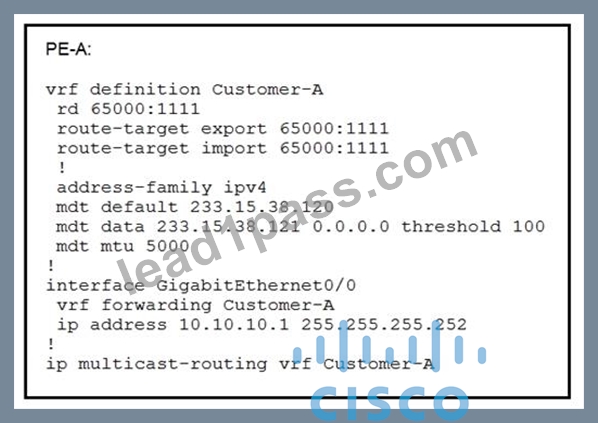
- A. PE-A(config-if)#no ip pim bsr-border
- B. PE-A(config-if)#ip pim sparse-mode
- C. PE-A(config-if)#ip pim sparse-dense-mode
- D. PE-A(config-if)#ip igmp version 3
Answer: C
NEW QUESTION # 183
Refer to the exhibit.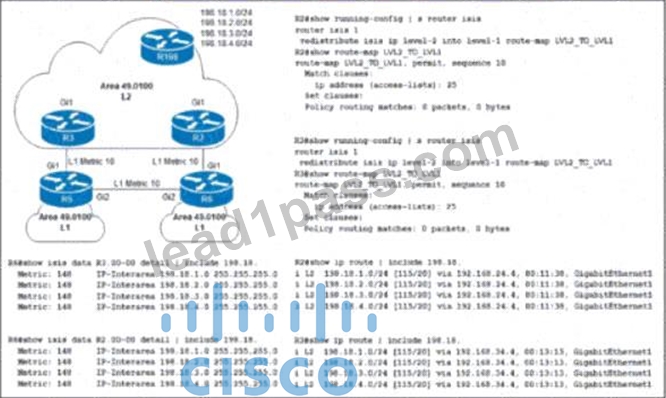
Routers R2 and R3 are Level 1/Level 2 IS-IS routers that redistribute 198 18.x.x/24 prefixes to routers R5 and R6 In the Level 1 area R2 Is to be the preferred router for all redistributed prefixes in the Level 1 area. Which configuration sets this preference?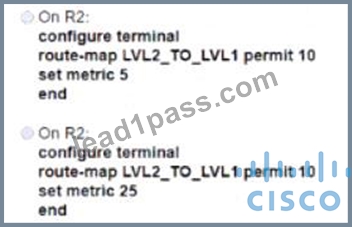
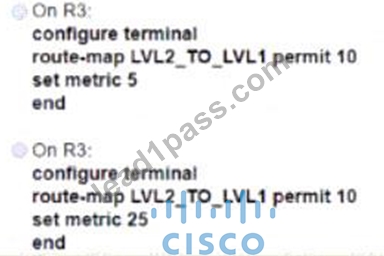
- A. Option C
- B. Option A
- C. Option D
- D. Option B
Answer: B
NEW QUESTION # 184
Refer to the exhibit.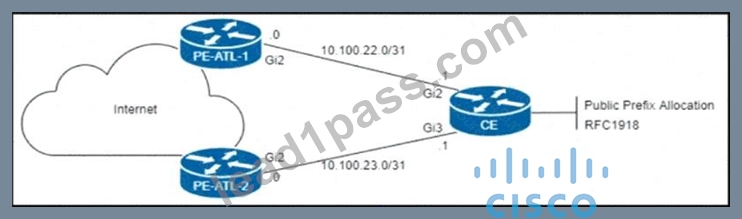
The CE router is peering with both PE routers and advertising a public prefix to the internet. Routing to and from this prefix will be asymmetric under certain network conditions, but packets must not be discarded.
Which configuration must an engineer apply to the two PE routers so that they validate reverse packet forwarding for packets entering their Gi2 interfaces and drop traffic from the RFC1918 space?
- A. interface GigabitEthernet 2
ip verify unicast source reachable-via rx - B. ip verify unicast source reachable-via rx allow-default
- C. ip verify unicast source reachable-via any allow-default
interface GigabitEthernet 2 - D. ip verify unicast source reachable-via any
Answer: D
NEW QUESTION # 185
Refer to the exhibit. After a networking team configured this MPLS topology, the supervisor wants to view MPLS labels to verify the path that packets take from router R1 to router R7. The team already issued an ICMP ping to verify connectivity between the devices. Which task must the team perform to allow the supervisor to view the label switch path?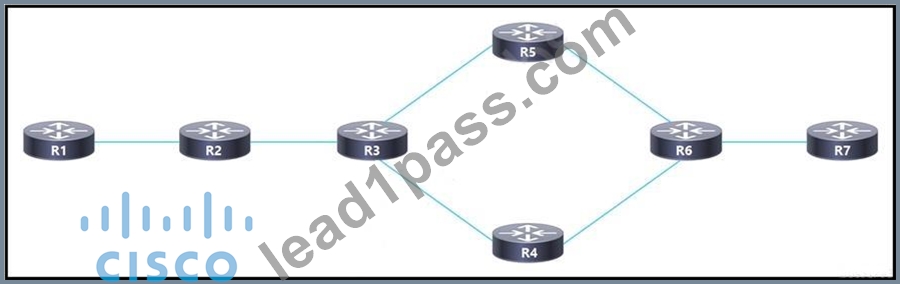
- A. Implement MPLS LDP to assign labels to all the routes in the transit path.
- B. Implement MPLS OAM to display the labels for each hop along the path
- C. Configure MPLS TE to display the labels in the stack between the head and tail-end routers
- D. Configure MPLS LDP Sync to sync labels from the routing table to the MPLS forwarding table.
Answer: B
NEW QUESTION # 186
Refer to the exhibit.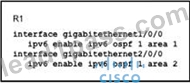
An engineer implemented OSPF neighbor relationship on an IOS device. Which configuration must be applied to get the OR/BOR election removed from interfaces running OSPF?
- A. ip ospf network broadcast on interfaces running OSPF
- B. ip ospf network multipoint-point on interfaces running OSPF
- C. ip ospf network non-broadcast on n:erfaces running OSPF
- D. ip ospf network point-to-point on interfaces running OSPF
Answer: C
Explanation:
In OSPF, the election of the designated router (DR) and backup designated router (BDR) is based on the OSPF network type. The network types include:
Broadcast: This is the default network type for Ethernet interfaces. In a broadcast network, OSPF elects a DR and BDR. All other routers become DROTHERs. To prevent the election of a DR/BDR, you can configure the interface as non-broadcast (NBMA) using the ip ospf network non-broadcast command.
Point-to-Point: This network type is used for point-to-point links (e.g., serial links). There is no DR/BDR election in point-to-point networks.
Point-to-Multipoint: This network type is used for point-to-multipoint links (e.g., Frame Relay). There is no DR/BDR election in point-to-multipoint networks.
Point-to-Multipoint Non-Broadcast: Similar to point-to-multipoint, but explicitly configured as non-broadcast. There is no DR/BDR election in point-to-multipoint non-broadcast networks.
Loopback: Loopback interfaces are always treated as point-to-point.
Virtual-Link: Used for OSPF virtual links.
Sham-Link: Used for OSPF sham links.
Demand Circuit: Used for demand circuits (e.g., ISDN).
Non-Broadcast: Explicitly configured as non-broadcast. There is no DR/BDR election in non-broadcast networks.
Reference:
Implementing and Operating Cisco Service Provider Network Core Technologies (SPCOR) v1.0 Cisco Learning Network Store - SPCOR Training
NEW QUESTION # 187
According to RFC5305 on IS-IS extensions for traffic engineering, what is the 4-octet sub-TLV type 10 of extended IS-IS reachability TLV type 22?
- A. IPv4 neighbor address
- B. maximum reservable link bandwidth
- C. TE default metric
- D. administrative group (color)
Answer: B
Explanation:
RFC 5305 extends the IS-IS protocol for traffic engineering by specifying new information that an Intermediate System (router) can place in Link State Protocol Data Units (LSPs). Sub-TLV type 10 of the extended IS-IS reachability TLV type 22 is used to specify the maximum reservable link bandwidth. This is an important parameter for traffic engineering as it defines the amount of bandwidth that can be reserved by traffic engineering algorithms for use in constrained-path computations for MPLS traffic engineering Label Switched Paths (LSPs). Reference: RFC 53051.
NEW QUESTION # 188
A mod-size service provider uses L2VPN as its standard for connectivity between offices. A small company wants the service provider to connect the company's two sites across the service provider core. To meet service requirements, the service provider must extend the layer 2 domain between the company's two locations. Which configuration must the engineer apply to implement an attachment circuit between the two sites using a VLAN tag of 12?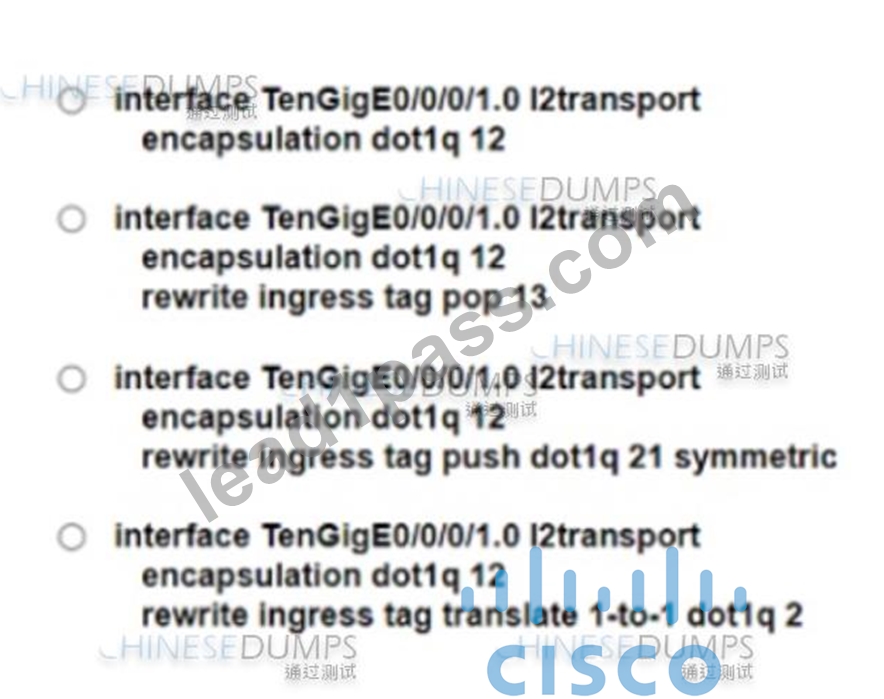
- A. Option C
- B. Option A
- C. Option D
- D. Option B
Answer: B
NEW QUESTION # 189
How can shared services in an MPLS Layer 3 VPN provide Internet access to the customers of a central service provider?
- A. Static routes on CE routers allow route leakage from a PE global routing table
- B. Route distinguishes are used to identify the routes that CEs can use to reach the Internet
- C. The CE router can establish a BGP peering to a PE router and use the PE device to reach the Internet
- D. The customer VRF uses route targets to import and export routes to and from a shared services VRF
Answer: D
Explanation:
https://community.cisco.com/t5/service-providers-documents/providing-internet-access-for-mpls- l3-vpns/ta-p/3109924
NEW QUESTION # 190
Refer to the exhibit: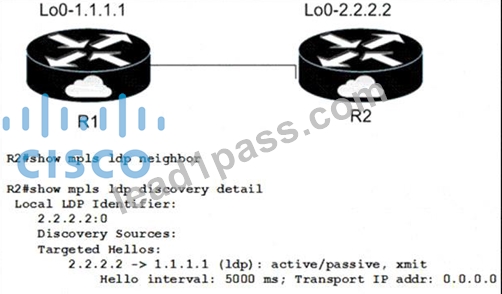
When implementing an LDP protocol, an engineer experienced an issue between two directly connected routers and noticed that no LDP neighbor exists for 1.1.1.1.
Which factor should be the reason for this situation?
- A. LDP needs to be enabled on the R2 loopback interface
- B. LDP needs to be enabled on the R2 physical interface
- C. R2 does not see any hellos from R1
- D. R2 sees the wrong type of hellos from R1
Answer: C
Explanation:
The issue of no LDP neighbor existing for 1.1.1.1 between two directly connected routers could be due to R2 not receiving any hellos from R1. In the context of LDP (Label Distribution Protocol), hellos are used for the discovery of LDP peers. They are sent periodically on each interface that LDP is enabled on to discover and maintain LDP sessions with neighbors. If R2 is not seeing any hellos from R1, it means there's a failure in the initial step of establishing an LDP session, hence no neighbor relationship is formed.
Implementing and Operating Cisco Service Provider Network Core Technologies source documents or study guide can provide more insights into the workings and troubleshooting steps for LDP protocol.
NEW QUESTION # 191
Refer to the exhibit.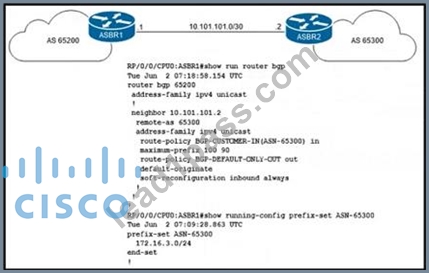
A network engineer is implementing a standard customer route-policy on ASBR1 with these requirements:
* It must accept only customer-assigned prefixes
* It must preserve customer advertised BGP communities
* It must set the local-preference to 110 for all prefixes
* It must attach the ORIGINATION-PE and LOCAL-CITY communities to all accepted prefixes.
Which route policy must the engineer implement on ASBR1 to satisfy the requirements?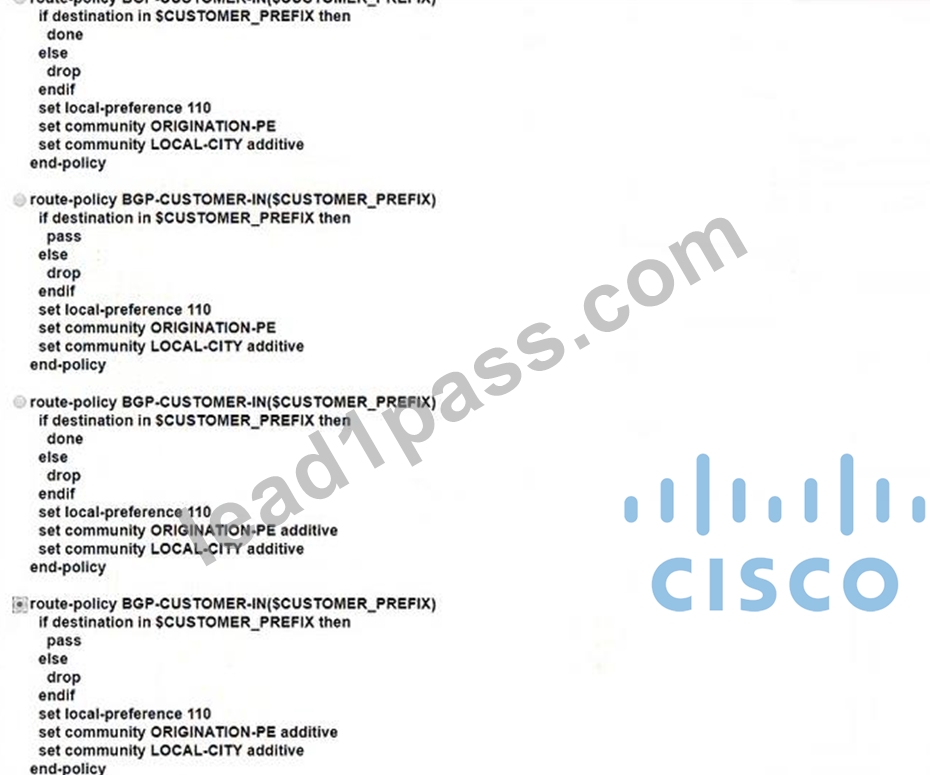
- A. Option D
- B. Option B
- C. Option A
- D. Option C
Answer: D
Explanation:
The correct route policy to satisfy the requirements is Option C. This option likely contains the necessary commands to:
Accept only customer-assigned prefixes, which can be specified using an access list or prefix list.
Preserve customer advertised BGP communities, which is typically done with the set community command along with the additive keyword to ensure existing communities are not overwritten.
Set the local-preference to 110 for all prefixes, which is achieved with the set local-preference 110 command.
Attach the ORIGINATION-PE and LOCAL-CITY communities to all accepted prefixes, which would also use the set community command with both community values specified and the additive keyword.
NEW QUESTION # 192
Refer to the exihibit.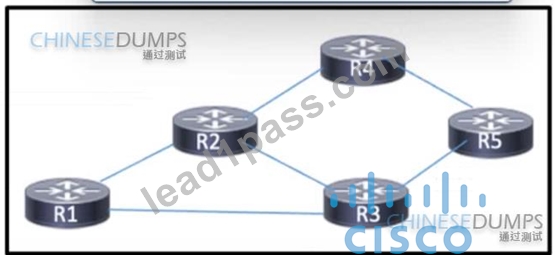
Refer to the exhibit. Routers R1 through R5 are being deployed within the core of a service provider running BGP The core supports distribution of VPNv4 routes using MPLS. R3 currently has multiple paths to reach R4. A network engineer must implement BGP attributes so that R3 can reach R4 via R1. Which action must the engineer take to meet the requirement?
- A. Configure R3 so the route to R4 through R1 will have a higher weight than the route from R2 or R5.
- B. Configure R5 to send the route from R4 to R1 using a longer AS path than the AS path that it receives from R1 or R2.
- C. Configure R3 so the route to R4 through R1 will have a lower local preference than the route from R2 or R5
- D. Configure R2 to send the route from R4 to R1 using a higher metric than what is advertised to R3.
Answer: A
Explanation:
To direct traffic from R3 to R4 via R1, the weight attribute on R3 can be set higher for the route through R1 compared to other routes. Weight is a Cisco-specific BGP attribute that determines the preferred path when multiple routes to the same destination exist. It is local to the router on which it is configured and not advertised to other BGP peers.
Reference:
Implementing and Operating Cisco Service Provider Network Core Technologies (SPCOR) course materials.
NEW QUESTION # 193
Refer to Exhibit: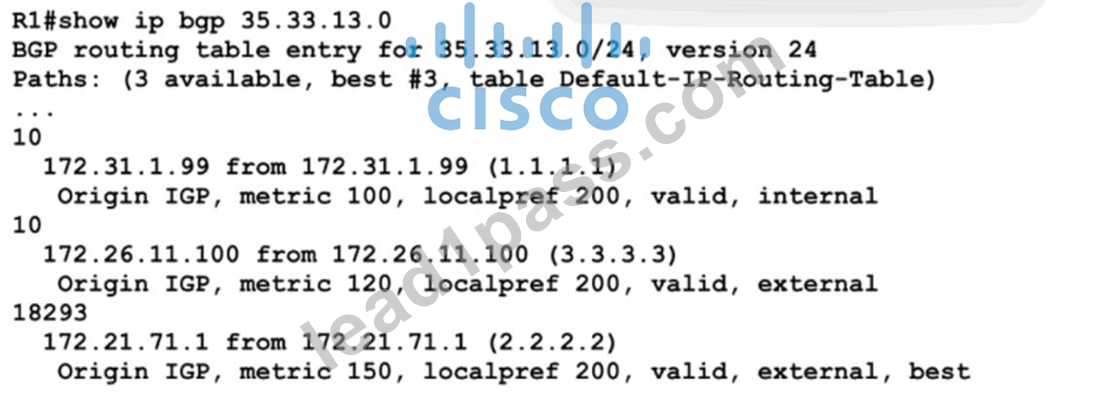
A network engineer must update the routing toward the web server with IP address 35.22.13.1. The primary path must be configured via the neighbor router with ID 1.1.1.1. However, local-preference configuration is not permitted on R1. Which task must the engineer perform on R1 to complete the implementation?
- A. Enable MED comparison between routes from neighbors in different AS.
- B. Set the device to ignore the conditional MED if the route originated in a different autonomous system.
- C. Configure the device to choose the best MED from the same AS.
- D. Implement deterministic MED to choose the best route from the different AS.
Answer: A
NEW QUESTION # 194
Simulation 5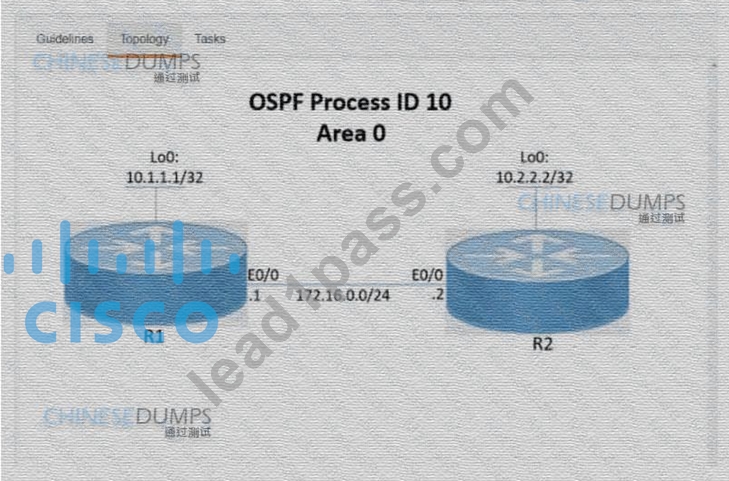
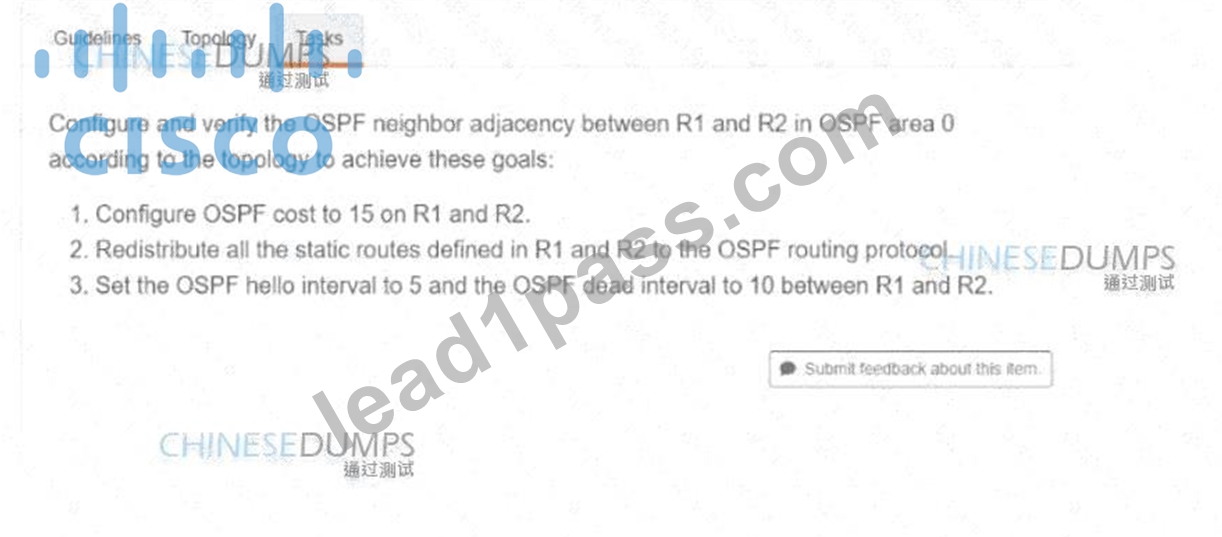
Answer:
Explanation:
See the solution below:
Explanation:
R1
router ospf 10
redistribute static
int et0/0
ip ospf hello-interval 5
ip ospf dead-interval 10
ip ospf cost 15
ip ospf 10 area 0
copy run start
R2
router ospf 10
redistribute static
int et0/0
ip ospf hello-interval 5
ip ospf dead-interval 10
ip ospf cost 15
ip ospf 10 area 0
copy run start
NEW QUESTION # 195
Refer to the exhibit.
An engineer is configuring multitiopology IS-IS for IPv6 on router R1. Which additional configuration must be applied to complete the task?
A)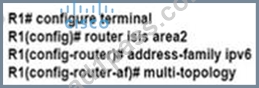
B)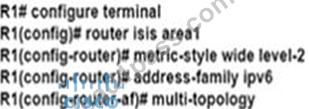
C)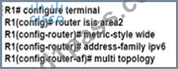
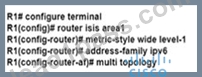
- A. Option D
- B. Option B
- C. Option A
- D. Option C
Answer: D
NEW QUESTION # 196
Which statement describes the advantage of a Multi-Layer control plane?
- A. It minimizes human error configuring converged networks.
- B. It automatically provisions, monitors, and manages traffic across Layer 0 to Layer 3.
- C. It supports dynamic wavelength restoration in Layer 0.
- D. It provides multivendor configuration capabilities for Layer 3 to Layer 1.
Answer: D
Explanation:
Section: Architecture
NEW QUESTION # 197
Drag and drop the functions from the left onto the correct Path Computation Element Protocol roles on the right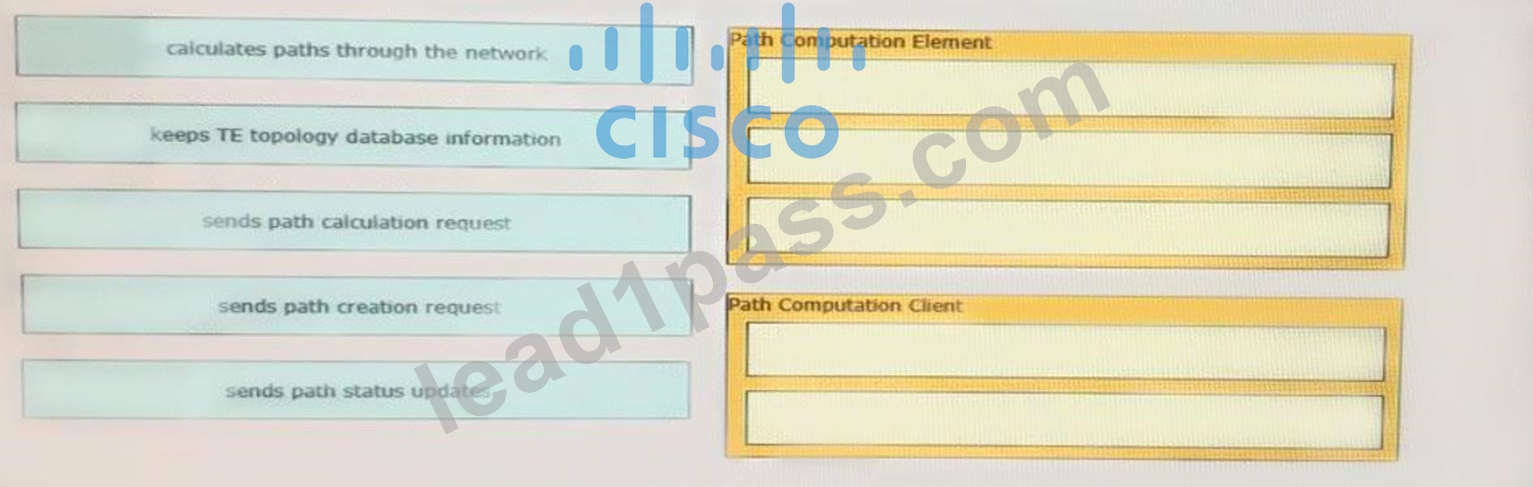
Answer:
Explanation: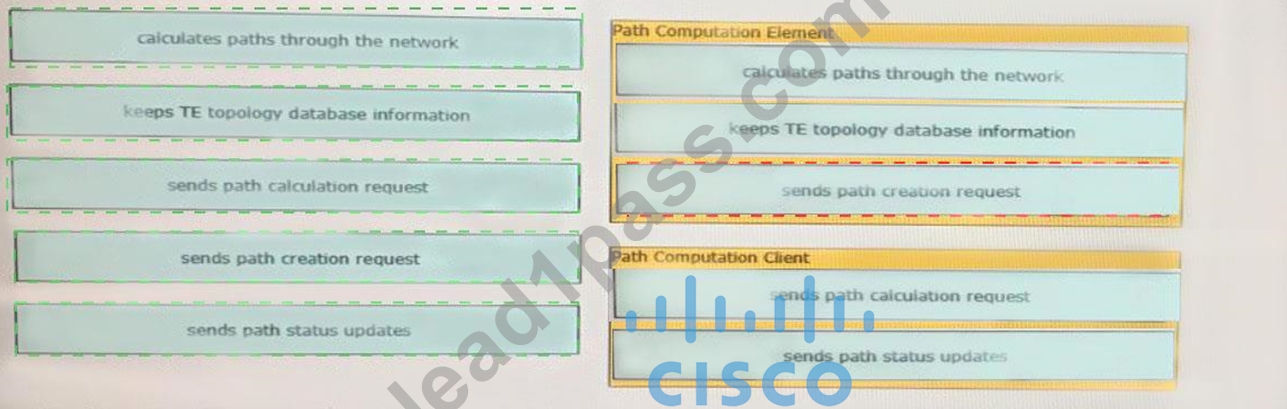
Explanation
Path Computation Element (Calculates paths through the network, keeps TE topology database information, sends path status updates) Path computation Client (sends path calculation request, sends path creation request) Path Computation Element (PCE) Represents a software module (which can be a component or application) that enables the router to compute paths applying a set of constraints between any pair of nodes within the router's TE topology database. PCEs are discovered through IGP.
Path Computation Client (PCC)
Represents a software module running on a router that is capable of sending and receiving path computation requests and responses to and from PCEs. The PCC is typically an LSR (Label Switching Router).
https://www.cisco.com/c/en/us/td/docs/routers/crs/software/crs_r5-3/mpls/configuration/guide/b-mpls-cg53x-crs
NEW QUESTION # 198 
Guidelines
-
This is a lab item in which tasks will be performed on virtual devices.
* Refer to the Tasks tab to view the tasks for this lab item.
* Refer to the Topology tab to access the device console(s) and perform the tasks.
* Console access is available for all required devices by clicking the device icon or using the tab(s) above the console window.
* All necessary preconfigurations have been applied.
* Do not change the enable password or hostname for any device.
* Save your configurations to NVRAM before moving to the next item.
* Click Next at the bottom of the screen to submit this lab and move to the next question.
* When Next is clicked, the lab closes and cannot be reopened.
Topology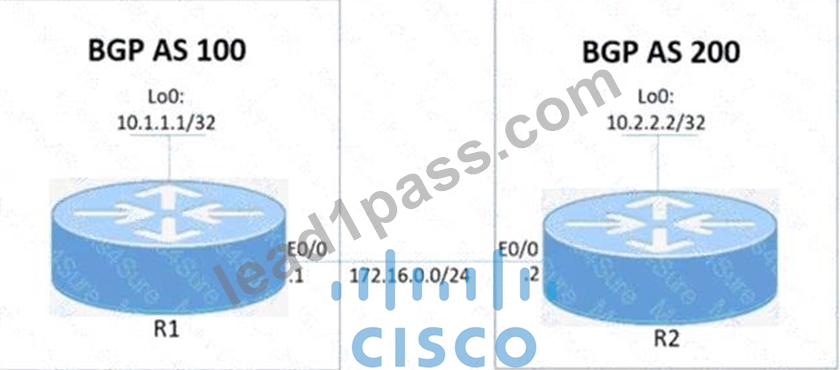
Tasks
-
R1 and R2 are having issues forming an eBGP neighbor relationship. Troubleshoot and resolve the issue to achieve these goals:
1. Configure R1 and R2 to form a BGP neighborship using their Loopback interfaces.
2. Form the neighbor relationship using a BGP multihop mechanism. Use minimal values to solve the issue.
Answer:
Explanation:
See the explanation for the solution.
Explanation:
Here is the solution: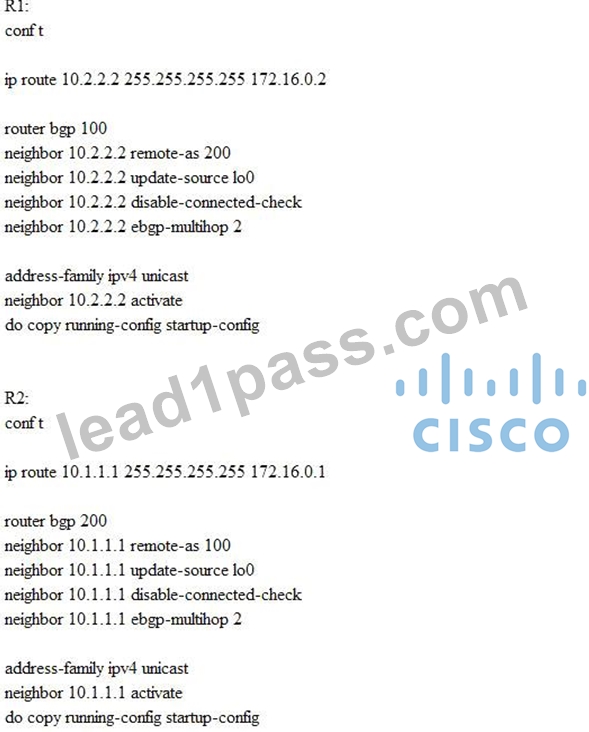
NEW QUESTION # 199
Refer to the exhibit: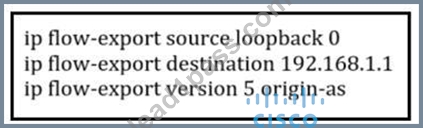
It the NetFlow configuration is updated to version 9, which additional piece of information can be reported"?
- A. flow sequence numbers
- B. IPv4 flow information
- C. BGP AS information
- D. IPv6 flow information
Answer: D
NEW QUESTION # 200
Refer to Exhibit.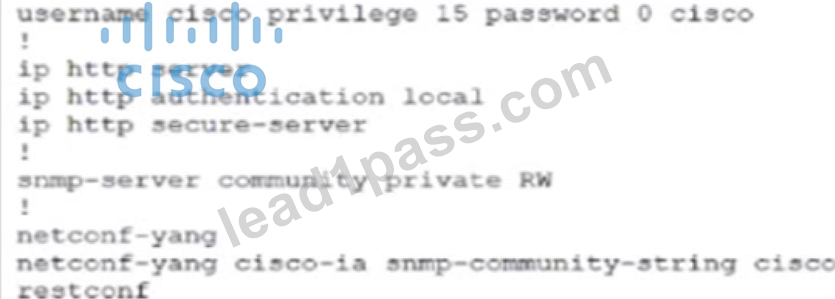
A network engineer is trying to retrieve SNMP MIBs with RESTCONF on the Cisco switch but fails. End-to-end routing is in place. Which configuration must the engineer implement on the switch to complete?
- A. netconf-yang cisco-Ia snmp-community-string Private
- B. snmp-server community public RO
- C. netconf-yang cisco-ia snamp-community -string Public
- D. snmp-server community cisco RW
Answer: D
NEW QUESTION # 201
......
Exam Details
Cisco 350-501 is a core exam and the applicants will have 120 minutes to cover all the questions of its content. There will be about 90-110 items that can be presented in the following formats: multiple choice, drag and drop, testlets, or fill-in-the-blank. The students are required to gain about 750-850 points for passing this test. Please note that this certification exam is available in English only.
Moreover, the test takers have to be ready to pay the fee of $400. This payment allows them to register and schedule the exam through the Pearson VUE platform that provides them with the opportunity to choose the appropriate delivery option. Thus, if you want to take Cisco 350-501 from the comfort of your office or home, you can opt for online testing. On the other hand, you can choose the in-person variant and have the exam at one of the Cisco testing centers.
Free 350-501 Dumps are Available for Instant Access: https://crucialexams.lead1pass.com/Cisco/350-501-practice-exam-dumps.html